Friday, September 6, 2013

Go Team Venture!

     Today's blog is a special, collaborative effort featuring my dear friend Erik. We met seven years ago when he trained me for my first day at work (I came in drunk), we went to Vegas together, he was the best man at my wedding, and in between we've talked about everything. I thought it would be a good idea to write some collaborative blogs, so here, to kick us off, is our top ten Film Protagonists. We each did five, in no order. I'll alternate between our two lists.

Erik:  Before I start in on this list of my own personal favorite main dudes of cinema, I should probably introduce myself. My name is Erik and I'm a friend of Dave's. I write a blog called Apocalypse Continuum, mostly detailing America's sometimes toxic relationship with technology, though I do occasionally step outside that framework to do things like this that I think are interesting or fun or otherwise helpful to get me excited about writing again. I'm not a huge list person, mostly because the ones I have tend to change frequently, but that doesn't mean these picks or their respective rankings are any less valid. This is, hopefully, the first of many collaborations on here. Sorry, guys.

 Dave:    We ended up taking a similar approach, although we didn't discuss it beforehand. I'll let Erik introduce his characters, but for me, I tried to pick protagonists who reflected something of my personality and character. I identify strongly with each, for better or worse, and that's what sets these five apart. They're not just great characters; they're facets of myself. First up...

Dave/1) Andy Dufresne - The Shawshank Redemption (1994)

     He crawled through a river of shit and came out clean on the other side. He's a lot like me in that he tends to be quiet and introspective, has nerdy hobbies, and, through no real fault of his own, finds himself handed a platter of shit for dinner. He's a reserved, soft spoken guy, but in his own way, Andy's kind of a radical. He follows no code or law except his own. He won't be broken. He looks at impossible odds, overwhelming circumstances, and he just starts chipping away. He takes it one day at a time, puts one foot in front of the other, and he keeps going until he's out of that prison or he's dead. Andy's a likable guy, but he doesn't have many close friends. He’s an intellectual who still likes his girly posters. These are all traits I identify strongly with.
      If Andy represents one thing, I think it's doing the best you can with what you're given. And, all things considered, if I had to come up with ground rules for living my life, I could probably do a lot worse.
He has a lot of good moments, but my favorite is probably the scene with the record player. It shows his appreciate for the arts and aesthetic beauty, and that he realizes some things are more important than covering your ass and maintaining the status quo. He saw an opportunity and he took it. And he showed the so called authorities that he wasn't their pet, and that he let them use him only as much as he saw fit. There's a lot being said in that scene.
      Where Andy finally ends up, on a solitary beach in Mexico, fixing up and old boat, is close to an ideal existence for me too. Symbolically, Andy Dufresne represents an arc that I see my life following, and that's why he's one of my favorite protagonists. He is the myth I aspire to.


Erik: These are in no particular order. The only reason it's these characters and not, say, Indiana Jones is that either I relate to each one as a man or aspire to be like them in some way. As far as role models go, you could do worse than...


Erik/1) Virgil Hilts - The Great Escape (1963)

 This is your dad's favorite war movie for one reason: Steve McQueen. McQueen plays US Air Force Captain Virgil Hilts, one of many Allied POWs determined to escape a German POW camp during WWII. Known as "The Cooler King" for the incredible number of days spent in solitary confinement, referred to as "The Cooler", he spends what little time he gets outside of a concrete cell attempting to escape or otherwise pissing off his jailors and cracking jokes. There's an air of calm to him I'd love to say I'd have in that situation; a sort of ultimate cool. Almost in the way that if you put out into the universe that you're not a POW in a cell surrounded by Nazis, then you're not a POW in a cell surrounded by Nazis. Some Zen shit. The image that comes to mind when I talk about this character(who was based on a real guy, BTW) is Hilts starting his twenty-day sentence in the cooler by sitting in his cell bouncing a baseball against a wall. You can't keep this man down. He dares you to even try.

Dave/2) "Sanjuro" - Yojimbo (1961)


     The ronin of Kurosawa's Yojimbo, who, when asked his name, replies "Kuwabatake Sanjuro". Thirty year old mulberry field. He is thirty, and he has no name. Sanjuro is an island unto himself. In the time the film (a deliberate mashup of samurai and Western films) is set, the lifestyle of the samurai is on its way out. Sanjuro is a wanderer, and he uses whatever skills he has acquired to his own advantage. He is amoral in a sense, but, such as when he saves the farmer and his wife, shows that he will perform acts of charity and goodwill if he finds them personally worthwhile.
     We meet Sanjuro wandering, and he determines his path by casting a stick into the air. The directions it points upon landing is where he will go. This sets the tone for the character. He encounters a town with two warring factions, and true to his nature, he uses them each to his advantage. He effortlessly plays one side against the other, and watches, amused, from a bell tower.
     Sanjuro is a man apart, and that's why I like him. He has no loyalty, but he isn't a scoundrel. He also does the best he can with what he has been given. As a representative of an era whose time has passed, he must stand alone against the world. There is a scene late in the film where Sanjuro has a pistol pointed at him. Up until now, his skill as a samurai rendered him untouchable, as he could easily kill anyone in the town without taking a scratch, but the gun equalizes the matter. Rather than killing or disarming his attacker, as he could surely do quite easily, he calmly faces whatever outcome awaits. This, metaphorically, is what Sanjuro has done with life. This is how I relate to him. The world is trivial and absurd. Do what you can, take what you can get, go where you feet lead you. What happens will happen.


Erik/2) William Munny - Unforgiven (1992)


 I thought at first to include Eastwood's "Man with no name" on this list, but instead decided on a much more interesting character, and what is probably my favorite role of his: William Munny, a widowed pig farmer who used to be a man of notoriously vicious and intemperate disposition. Hired to kill two cowboys that cut up a prostitute, Munny, along with his old partner Ned Logan (Morgan Freeman) and a young gunslinger, do as much, leading each to different fates. By the end, Munny accepts his violent past as still being a part of him, calling up his talents to dispatch several men in the saloon decorated with his now-dead partner, Ned. I guess the thing to come away with at the end of it is that violence, however naturally it comes to you, is ultimately useless. Nothing comes of it but pain and death. It should be noted this was Eastwood's last western.

Dave/3) Daniel Plainview - There Will Be Blood (2007)


     Another loner in the extreme, Daniel Plainview loathes seemingly everything and everyone, including himself. He represents the darker side of my nature. "I look at people and I see nothing worth liking." he says at one point, and "I cannot go on doing this by myself. With these... people." I have felt exactly that way many times. He wants to make money, but even his greed is misanthropic: "I want to earn enough money that I can get away from everyone."
     Plainview is an eminently watchable character. His diction and elocution are compelling. He's one of the less admirable characters on my list, but he is relatable just the same. His determination and his self-reliance are remarkable. One common theme I've noticed among my favorite protagonists is that they are each very solitary men. They are all self-sufficient, self-reliant. Daniel takes it to the extreme, but even he has his adopted son, H.W. Their relationship is tragic, but I think he does feel affection for the boy. He's just unable to be a decent, kind man. He doesn't have it in him. Like Sanjuro, Plainview takes what he can get from who he can get it from, but unlike Sanjuro, he is not at peace with himself. At all. This, too, is relatable, as I would aspire to be like Kurosawa's ronin, but it would be prideful and dishonest to say there's not a lot of Daniel Plainview in me too. He's also something of a drunk, which I can relate to, especially his hangover scenes. Those could have come straight from my life.
     That's life. We must take it as it comes. There's a perverse pleasure in Plainview, too. His rivalry with Eli is quite funny, and it's very satisfying to see Daniel snub Eli at the dedication, or laughingly explain about the milkshakes. One of the most cathartic scenes in any film though, has to be Daniel slapping Eli across the face and dragging him through the mud when Eli asks where the money is. I'm Plainview, the system is Eli.

Erik/3) R.J. MacReady - The Thing (1982)


If I had to pick a character I feel closest to, personality-wise, it'd be R.J. MacReady. A pilot for U.S. Outpost #31 in Antarctica, MacReady is a loner that would've gladly spent his nights in his shack drinking scotch and playing chess with his cheatin' bitch computer. Things didn't turn out that way, and he stepped up to handle the situation as best he could because no one else was willing to do it. Sounds like a role model to me. If you haven't seen it, it's based on John W. Campbell, Jr.'s short story, Who Goes There?, a kind of "Ten Little Indians" story where a group gets picked off one by one. I won't lie to you and say this one turns out well. The film's ending is one of the most nihilistic I've ever seen, and I've seen some dark shit. I could only hope to handle it as well as MacReady.


Dave/4)  Johnny - Naked (1993)
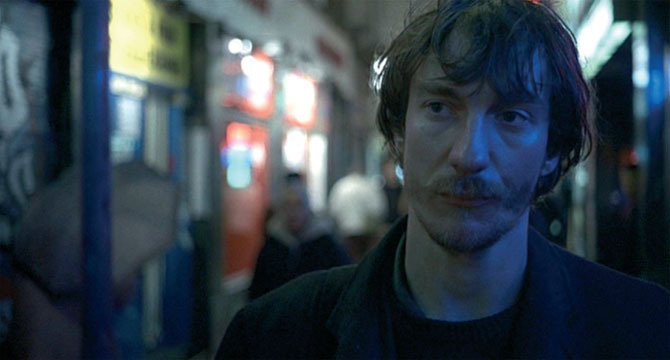


     Johnny is the darkest character on my list, even more than Daniel Plainview. He's smart, well read, clever and funny, but his good qualities end there. He definitely has a charisma to him, but he abuses it by being a selfish, basically awful person. It's not nice, but I've been very much like Johnny. Disillusioned with reality. I had no resources except my intellect, so I honed it, then used it as a tool to elevate myself over others and take advantage of them. Johnny is basically a nihilist, which I was for many years. It's not all bad. He is very, very funny. I think he could carry his quick wit even if he were to decide to stop being such a twat, as I hope I've done.
     David Thewlis plays him perfectly, and besides being the darkest character on my list, he's also probably the most quotable, which is saying a lot. His personal philosophy is quite similar to my own, I just hope I'm applying it in a different, better way these days.
     Johnny's best scene is with the security guard. He makes some very interesting insights into humanity and god, similar to stuff I've said (it could almost be word for word, just with a different accent and slang), but he's doing it to more or less fuck with a simple man who's only trying to be nice to him. This scene is the character in a nutshell.
     Johnny's a total loner, also, even more than Plainview, as he doesn't even have an H.W. Any positive interaction is a manipulation, as seen in the final scene. What a great scene, and what a bastard. I don't want to spoil it, because this film isn't as widely seen as the others on my list, but just the last shot of Johnny is incredible. It's the triumph of the human spirt and human cruelty and fuck all else rolled into one. It's an ugly world, and sometimes we're ugly people. Even me.

Erik/4) Chuck Noland - Cast Away (2000)

 How would you deal with being stuck on a desert island? Do you know how to build a fire? Make shelter? Catch fish? Deal with being completely and utterly alone? Maybe take a cue from Chuck here and learn to talk to a fucking volleyball to keep from going insane, if that makes any sense. Noland is a FedEx employee who gets stranded on an island in the South Pacific when his plane crashes. He uses what's left of the cargo to try and survive. That's a good summation of most of these characters. They make the best of a bad situation and attempt to pull themselves out with logic. Sometimes that process is a solo mission that takes years and is totally transformative, but you can end up a more capable, satisfied human being.

Dave/5) The Dude - The Big Lebowski (1998)


     Everybody loves the Dude. With good reason. The Dude is kind of the inversion of Johnny. Neither has much going for them, in a traditional sense, but the Dude is content, and basically kind and good. The Dude is closer to who I am now, and that's not a bad thing. He represents, again, doing the best with what you're given, but more importantly than that, being content with what you have. The Dude is almost like a real life Bugs Bunny. Think about it. Bugs just wants to be left alone with his carrots and his burrow, the occasional company of a lady rabbit, and time to read his book or whatever, and some lunatic is always hassling him, causing trouble. He rolls with it, and he comes out on top. Why? Cause he's just that kind of guy. Bugs Abides. 
     Bugs and the Dude are interesting because they're basically shiftless... I hesitate to say losers, because they totally aren't, but by the standards of the world, you could spin it that way. But I wasn't just talking fun, everybody loves the Dude. He's got to be one of the most popular film characters of the modern era. But why? There's really not much about him that sounds all that appealing on paper. And that's the key. It's his attitude. His joi de vivre. His contentment with the simple things. That's what I want to share with him. I'm a capital A Alcoholic, so no white Russians for me, but I enjoy pot, I've bowled, and I have at least one good friend to pass the time with (though Erik couldn't be more different than Walter if he was... black and lived underwater). What more do you need? Like the film itself and Sam Elliott's narration, this just kind of trails off, but so what? It's not about that. It's an attitude. A philosophy. The Dude abides, man. The Dude abides. 

Erik/5) Snake Plissken - Escape From New York (1981)


What can I say? Kurt Russell was a big part of my childhood movie watching experience. Seeing THE THING and ESCAPE FROM NEW YORK as a kid did a lot to inform my outlook on life: No one is to be trusted implicitly, so be prepared to walk away at a moment's notice. I've since amended that to include, "Be thankful for the time you had with them and what you learned from it." Snake probably wouldn't use the last part and instead just shoot the motherfucker that wronged him, but hey, I'm a real person, not a movie character with a big fuck-off gun and a license to kill. The point is, with Snake and all the rest of these guys, survival is paramount. Adapt or die. That's my philosophy.
 
"It is not the strongest of the species that survives, nor the most intelligent that survives. It is the one that is the most adaptable to change." -Charles Darwin


Monday, September 2, 2013

“Sometimes the questions are complicated and the answers are simple.” - Dr. Seuss

These are nineteen questions from Chuck Klosterman's IV. Chuck likes to ask odd questions, and this isn't his first list of them. I find these to be interesting, and, as readers of the Dark Tower know, nineteen is a mythical number. I will answer as best and as honestly as I can.

1. Think about your life. Think about the greatest thing you have ever done, and think about the worst thing you have ever done. Try to remember what motivated you to do the former, and try to remember what motivated you to do the latter... How similar are these two motives?

I'm glad this question didn't ask for an elaboration of what these things were, because there's no way I'd talk about it. As to the motivations, I'd have to say they were not similar at all. In fact, they are pretty close to being opposites. The former was due to complete and utter selfishness. The latter was due to selflessness and love. The opposite of love isn't hate. It's feeling nothing at all. And that was also true of the worst thing I ever did.

2. Think of someone who is your friend (do not select your best friend, but make sure the person is someone you would classify as "considerably more then an acquaintance"). This friend is going to be attacked by a grizzly bear. Now this person will survive the attack; that is guaranteed. There is a 100 percent chance that your friend will live. However, the extent of his injuries is unknown; he might receive nothing but a few superficial scratches, but he also might lose a limb (or multiple limbs). He might recover completely in twenty-four hours with nothing but a great story, or he might spend the rest of his life in a wheelchair. Somehow you have the ability to stop this attack from happening. You can magically save your friend from the bear. But his (or her) salvation will come at a peculiar price: if you choose to stop the bear, it will always rain. For the rest of your life, wherever you go, it will be raining. Sometimes it will pour and sometimes it will drizzle-but it will never not be raining. But it won't rain over the totality of the earth, nor will the hydrological cycle be disrupted; these storm clouds will be isolated, and they will focus entirely on your specific where-abouts. You will also never see the sun again. Do you stop the bear, accepting the lifetime of rain?

If I could cause it to permanently rain wherever I go, I would do that. For nothing.


3. Assume everything about your musical tastes was reversed overnight. Everything you loved, you now hate; everything you once hated, you now love. If your favorite band has always been REM, they will suddenly sound awful to you, they will become the band you dislike the most. Everything will become it's opposite, but everything will remain in balance (and the rest of your personality will remain unchanged). So-in all likelihood-you won't love music any less (or any more) then you do right now. There will still be artists you love and who make you happy; they will merely be the artists you currently find unlistenable. Now, I concede that this transformation would make you unhappy. But explain why.

Music is more than a trivial entertainment to me. It's an expression of deeper truths about myself and the world I live in. I couldn't just arbitrarily like all different stuff; the music I like is an extension of my personality. If I suddenly hated stoner metal and loved pop country, would it really be fair to say my personality hadn't changed beyond my musical taste? Also, I like a lot of different music. There's really very, very little I don't like. So if this theoretical transformation happened, I would dislike most music, and only enjoy a tiny fraction of artists, who represented a lifestyle and aesthetic radically different than my own.

4. At the age of thirty, you suffer a blow to the skull. The head trauma leave you with a rare form of partial amnesia-though otherwise fine, you're completely missing five years from your life. You have no memory of anything that happened between the ages of twenty-three and twenty-eight. That period of your life is completely gone; you have no recollection of anything that occurred during that five year gap.
You are told by friends and family that-when you were 25-you (supposedly) became close friends with someone you met on the street. You possess numerous photos of you and this person, and everyone in your life insists that you and this individual were best friends for over two years. You were (allegedly) inseparable. In face, you find several old letters and e-mails from this person that vaguely indicate you may have even shared a brief romantic relationship. But something happened between you and this individual when you were 27, and the friendship abruptly ended (and apparently-you never told anyone what caused this schism, so it remains a mystery to all). The friend moved away soon after the incident, wholly disappearing from your day-to-day life. But you have no memory of any of this. Within the context of your own mind, this person never existed. There is tangible proof that you deeply loved this friend, but-whenever you look at their photograph-all you see is a stranger.
Six weeks after your accident, you are informed this person suddenly died.
How sad do you feel?

Not at all. This is an interesting question, because I really do have almost no memory of the time between twenty-three and twenty-eight, because of my alcoholism. I've legitimately learned to just say fuck the past and move on, and that would apply to this hypothetical situation.

5. You work in an office performing a job that you find satisfying (and which compensates you adequately). The company that employs you is suddenly purchased by an eccentric millionaire who plans to immediately raise each person's salary by 5% and extend an extra week of vacation to all full-time employees.
However, this new owner intends to enforce a somewhat radical dress code: every day men will have to wear tuxedos, tails and top hats (during the summer months, men will be allowed to wear three piece grey suits on "casual Fridays"). Women must exclusively work in formal wear, preferably ball gowns or prom dresses. Each employee will be given an annual $500 stipend to purchase necessary garments, but that money can only be spent on work related clothing.
The new regime starts in 3 months.
Do you seek employment elsewhere? 
 
Certainly not! This sounds like a dream to me. If it was socially acceptable, and I could afford it, I'd dress like that anyway. It's an odd distinction, but while I don't think it's OK to be socially required to dress like that, it seems very fun and exciting if you happen to enjoy it, which I do.

6. You have been wrongly accused of a horrific crime: Due to a bizarre collision of unfortunate circumstances and insane coincidences, it appears that you have murdered a prominent U.S. senator, his beautiful young wife, and both of their infant children. Now, you did not do this, but you are indicted and brought to trial.
Predictably, the criminal proceedings are a national sensation (on par with the 1994 O.J. Simpson trial). It's on television constantly, and it's the lead story in most newspapers for almost a year. The prosecuting attorney is a charming genius; sadly, your defense team lacks creativity and panache. To make matters worse, the jury is a collection of easily confused sheep. You are found guilty and sentenced to four consecutive life terms with virtually no hope for parole (and - since there were no procedural mistakes during the proceedings - an appeal is hopeless).
This being the case, you are (obviously) disappointed.
However, as you leave the courtroom (and in the days immediately following the verdict), something becomes clear; the "court of public opinion" has overwhelmingly found you innocent. Over 95 percent of the country believes you are not guilty. Noted media personalities have declared this scenario "the ultimate legal tragedy." So you are going to spend the rest of your life amidst the general population of a maximum-security prison...but you are innocent, and everyone seems to know this.
Does this knowledge make you feel (a) better, (b) no different, or (c) worse?

I don't accept that I would be stuck in prison for life if everyone believes I'm innocent. Whatever the system says, you can get around it. There'd be a movement to free me. That said, under those conditions, I'd feel better, because I would truly believe I had a chance. On the other hand, if I accept the hypothetical that I will never get out of prison, I'd feel worse, because if I truly had no hope of release, I'd become a monster. I'd become the most feared, psychotic Simon Adebisi/Vern Schillinger motherfucker in that prison. And that would use up everyone's good will pretty quick.

7. You are offered a Brain Pill. If you swallow this pill, you will become 10 percent more intelligent than you currently are; you will be more adept at reading comprehension, logic, and critical thinking. However, to all other people you know (and to all future people you meet), you will seem 20 percent less intelligent. In other words, you will immediately become smarter, but the rest of the world will perceive you as dumber (and there is now way you can ever alter the universality of this perception).
Do you take this pill?

Yes. What kind of moron considers the perception of intelligence to be more important than intelligence? Appearing less intelligent than you are is tactically advantageous, as well. This is a win/win.

8. You begin watching a new television series, and you immediately find yourself strongly relating to one of the supporting characters. You've never before experienced a TV character that seems so similar to yourself; this fictional person dresses, behaves and talks exactly like you. And - slowly, over the course of several episodes - the similarity grows spooky; on two separate occasions, the character recounts personal anecdotes that happened in your real life. The actor portraying this character begins mimicking your mannerisms. In at least three different episodes, the character's dialog quotes things that you have said (verbatim) during casual conversation.
You become convinced that this is neither coincidence nor mental illness: somehow, this character is being actively based on your life. The show's writers generally depict the "you" character in a positive manner, but - as far as you can tell - you don't know anyone involved in the show's production or creation. It's totally inexplicable.
You have two friends who also watch this show. One of them is certain that your theory is correct and that (somehow) the character is, in fact, based on your life. She tells you to get a lawyer. The second friend concedes that many of the similarities are amazing, but that the whole notion is ridiculous, impossible, and egocentric. He tells you to see a therapist.
How do you respond to this situation? Do you do anything?


I might contact the show out of curiosity, but I really wouldn't care too much about this one way or the other. I'd just roll with it. Cal from 40 Year Old Virgin was like 85% me, anyway.

9. If given the choice, would you rather (a) only abide by the rules and moral of society that you personally agree with, or (b) have the power to slightly adjust the rules and morals that currently exist (but these adjustment would then apply to you and everyone else, all the time)? 
 
I do option A anyway. The rules and morals of society mean nothing to me.

10. You are placed in the unenviable position of having to compete for the right to stay alive.
You will be matched against a person of your own gender in a series of five events- an 800-meter run, a game of Scrabble, a three-round boxing match, a debate over the legalization of late-term abortion ( scored and officiated by reputable collegiate judges) and the math portion of the SAT.
In order to survive, you must win at least three of these events (your opponent will be playing for his or her life as well). However, you (kind of) get to pick your opponent: you can either (a) compete against a person selected at random, or (b) you can compete against someone who is exactly like you. If selected at random, the individual could be of any age or skill level-he/she might be an infant with Down syndrome, but she might also be an Academic All-American linebacker from Notre Dame. If you pick "the average human," he/she will be precisely your age and will have an identical level of education, and the person will be a perfect cross-section of your particular demographic-he/she will be of average height and of average weight, with a standard IQ and the most normative life experience imaginable.
So whom do you select? Or-perhaps more accurately-do you feel that you are better than an average version of yourself?

I'd go with someone exactly like me. I'm self educated and I come from poor white trash, so I would crush them in the debate and Scrabble events, and probably the math. That's got it, but I'd feel confident that I could pull another event too. If someone can run faster than me, I can probably beat them up, and if they can beat me up, I'm probably faster than them. I'm a Jack of both skills. Definitely the "me" option. I got it on lock.

11. It is 1933. You are in Berlin, Germany. Somehow you find yourself in position to effortlessly steal Adolf Hitler's wallet. This theft will not affect Hitler's rise to power, the nature of World War II, or the Holocaust. There are no important papers in the wallet, but the act will cost Hitler forty Reichsmarks and completely ruin his evening. You do not need the money. The odds that you will be caught are less than 2% but if caught you will be executed. Are you ethically obligated to steal Hitler's wallet?

Ruin Hitler's night for a 2% chance you'll be killed? That's absurd. What possible difference could that make regarding... anything? I know this wasn't the question, but I wouldn't kill Hitler either. Killing Hitler is way, way too big of a butterfly. You could easily doom humanity or something.

12. How would your views about war, politics and the role of the military change if all future conflicts were fought by armies of robots (that is to say, if all nations agreed to conduct wars exclusively with machines so that human casualties would be virtually non-existent)?

If you extrapolate this, the question is meaningless. What are you fighting over? Our robots are better than yours, so we can dictate what your country will do, or else... what? There's no viable war being fought. Unless the robots come in and kill your citizens when they defeat the opposing army (in which case, it's a lateral move), you're playing by the honor system. It's like if someone had sex with your girlfriend, so you kicked his ass in Street Fighter. No question here.

13. You are in a plane crash in the Andes Mountains, not unlike those people from the movie Alive. As such, you will be forced to consume the human flesh of the people who died on impact; this will be a terrible experience but it is the only way for you to survive. Fortunately, you did not know any of the victims personally.
Would you rather eat a dead baby, or would you rather eat a dead elderly person? Would you gender play a role in your selection process? And how much would it bother you if this meat turned out to be delicious? 
 
I wouldn't have a problem eating human flesh; in fact, I'd be kind of curious about it. Wendigo FTW. So I wouldn't care if it was delicious. As far as preferences, well... an elderly person would probably provide more meat than a baby.  It's not asking me if I'd kill someone to eat them, so really, it doesn't matter much. I would probably be somewhat bothered eating a baby because I have a baby, but I imagine I could compartmentalize that in my mind sufficiently enough to do it. Gender wouldn't matter.

14. Is there any widespread practice more futile than attempting to predict society's future relationship with technology?

I don't find that futile, as it's been done pretty successfully, by numerous Sci-Fi authors, and even by tech corporations. Shows what you know, Chuck.

15. While traveling on business, your spouse (whom you love) is involved in a plane crash over the Pacific Ocean. It is assumed that everyone on board has died. For the next seven months, you quietly mourn. But then the unbelievable happens: it turns out your spouse has survived. He/She managed to swim to a desert island, where he/she lived in relative comfort with one other survivor (they miraculously located most of the aircraft's supplies on the beach, and the island itself was filed with ample food sources). Against all odds, they have just been discovered by a Fijian fishing boat.
The two survivors return home vie helicopter, greeted by the public as media sensations. Immediately upon their arrival, there is an international press conference. And during this press conference, you cannot help but notice how sexy the other survivor is; physically, he/she perfectly embodies the type of person your mate is normally attracted to. Moreover, the intensity of the event has clearly galvanized a relationship between the two crash victims: they spend most of the interview explaining how they could not have survived without the other person's presence. They explain how they passed the time by telling anecdotes from their respective lives, and both admit to admit to having virtually given up on the possibility of rescue. They share a tearful good-bye hug. It's extremely emotional.
After the press conference you are finally reunited with your spouse. He/She embraces you warmly and kisses you deeply.
How long do you wait before asking if he/she was ever unfaithful to you on this island? Do you never ask? And if your mate's answer is "yes," would that (under these specific circumstances) be acceptable?

I would never ask. I'm not the jealous type, and I assume the "unfaithful" in the question is talking about sex, which wouldn't bother me. In fact, I'd kind of expect it if two people were stranded on an island, whether they were super compatible or not. I'm bothered by "cheating" with emotional intimacy, not sex, and that has clearly occurred between the survivors. It isn't cheating in those circumstances, though, certainly, and is perfectly acceptable and understandable. You'd have to be a pretty insecure douche to get hung up about this sort of thing.

16. Let us assume you have the ability to telekinetically change culture while you actively experience it. Your mind can now dictate what you see and hear. For example, if you were listening to Pear Jam's Yield and you wanted the music to be heavier, it would immediately sound as though Mike McCready's guitar had been tuned differently in the studio. If you were watching The Office on NBC and decided that Jim should marry Pam (or Karen, or both), you could make it happen--all you would need to do is think about that specific desire. You could stare at an oil painting and unconsciously change the color contrasts. If a PG13 romantic comedy grew dull, you could force it to evolve into an eroticized NC-17 thriller. You could (essentially) write books as you read them, eliminating certain characters and redirecting plot points as the occurred in the text. However, such changes would only apply to your experience; you could kill off Han Solo at the end of Return of the Jedi, but htat would not change the movie for anyone else. All other people would posses the same personal telekinetic powers as you.
Would you want this? And--if this became a reality--would art retain any meaning whatsoever?

Oh man, I so want this. I've often said if I found a genie's lamp, my first wish would be omnipotence and I wouldn't need the other two. When I contemplate omnipotence, this exact thing is one of the things I'd love to do with it. Art would definitely have meaning, you'd just have to view it with self imposed limits. That's like saying running has no meaning because we have cars.

17. You die from natural causes.
Upon death, you are absorbed skyward. You ascend toward a warm, white light. You immediately realize you have entered the afterlife...and (much to your surprise) it is exactly like the cliched conventional, kindergarten version of Christian heaven. You enter through gates made of pearl. The ground is covered by a white, cloud like fog. Angels fly around you and play the hard. You are wearing a comfortable white robe. Everyone there is aimlessly walking around, smiling broadly, perfectly content; this, it seems, is how you will spend eternity.
Upon your arrival, you are greeted by Jesus (and he looks exactly like the stereotypical depiction of Jesus). "Welcome to heaven," he says. "I think you will like it here, and I look forward to loving you unconditionally for the duration of time. But I also realize heaven isn't necessarily for everyone, so I always give newcomers a chance to go to the other place, if that's what they would prefer."
"Are you referring to hell?" you say in response.
"Oh, no," says Jesus. "Not hell. Certainly not hell. I would never send you to hell. But you can go to somewhere that isn't here. It's a viable post-life option. About 18% of our potential residents go in that direction."
"What is the other place like?" you ask.
"I can't tell you," says Jesus. "But if you do elect to go there, you can never come back here. And you only have 20 minutes to decide."
"Why only 20?" you ask.
"Because I am Jesus," says Jesus.
What do you do?


LOL

18. The world is ending. It's ending quickly, and it's ending dramatically. It will either end at noon on your fortieth birthday, or it will end two days after you die (from natural causes) at the age of seventy-five. Which apocalyptic scenario do you prefer?

I'd live to 75. I'd rather not kill my daughter when she's 11, but even if I were childless, I'd wring it for all it's worth, Alan Arkin in Little Miss Sunshine style.

19. You are given the chance to control what your legacy will be. You can't specifically dictate how you will be recalled by future generations, but you are given the chance to choose between two general idioms of legacies.
The first kind of legacy ("option A") would be that you lived your days as a good, honest person who worked hard and contributed to society. However, the limitation of this legacy will be that almost no one will know or remember this information (including future members of your own extended family). Most average people will never even know you lived.
The second kind of legacy ("option B") will be familiar to almost everyone in the world for centuries to come. However, this legacy will be extremely strange and neutral; it will be an obscure fact that has almost nothing to do with your tangible day-to-day life (the best comparison being the legacy of General Tso Tsungtang, an extremely gifted and successful military leader during the seventeenth-century Qing Dynasty who is now exclusively remembered as the namesake for the popular Chinese dish General Tso's chicken).
Which legacy do you want?

I really don't care how I'm remembered after I'm dead. I'm dead, after all. But I'd choose option A, if only because option B is a non-legacy. Using his example (and Chuck apparently doesn't know what "exclusively" means), I don't think most people even think General Tso is a real person. Your name is being remembered, but it has nothing whatsoever to do with you, and it's not like I have all that unique of a name. If there was a David T. McLaughlin's Chicken, it would not be a legacy at all. There was a president of Dartmouth with the exact same name as me. Why wouldn't the metaphorical chicken dish be associated with the Dartmouth president? It's meaningless. Who would say "Nah, fuck contributing to society. I want my name on a sandwich."?